
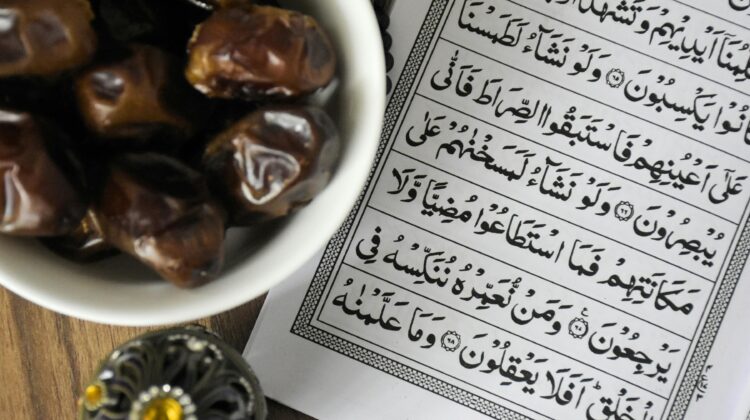
A Isolated Revert’s Guide to Ramadan
When scrolling social media during Ramadan, we often see photos and videos from other people’s celebrations: group photos from community iftars, videos of other Muslims in uniform rows performing taraweeh. For those of us without a place, it can make us feel the full weight of our isolation, paired with the physical strain of fasting; it can be miserable. However, within that struggle, it’s easy to feel like this time of year will always be like this, but from someone who’s been there, let me assure you, it doesn’t have to be like that. There are many mercies Allah put in front of you that can be used to keep you motivated and ease the loneliness you might be struggling with.
Before I proceed, I would like to make a note that this post is written as a follow-up to a blog entry I wrote for Embrace reverts: https://embracereverts.org/2026/02/14/welcome-ramadan-2026. I recommend reading it if this is your first Ramadan or if you need a refresher on the major practices.
The Value of Jihad
The first thing to remember is that this is your jihad. It might sound perposterous to you as the word is often associated with the battlefield, but jihad is a comprehensive word literally meaning “struggle.” Jihad refers to any difficulty we face; in fact, there is a very well-known story showing that Jihad-an-nafs, aka “Struggle with our desires,” is the greatest type:
“Ibrahim B. Abi’ Ablah said to some people who had just returned from a military campaign: ‘You have returned from the lesser jihad. But what have you done about the greater jihad?’ They asked: ‘What is the greater jihad?’ He replied: ‘Jihad of the heart.'”
There is the potential for a mountain of deeds in what you are going through, dear reader. Your patience right now will become one of the most valuable resources on the Day of Judgment.
Ramadan is Special
Any deed we do right now will have more weight now than at any other time of year, even more so during the last ten nights. The excitement in this month isn’t within all the cool stuff that people are doing with each other, it is within Allah’s mercy, in the extra deeds that we do, in the freedom from Shaytan. Consider the following hadiths:
“When there comes the month of Ramadan, the gates of mercy are opened, and the gates of Hell are locked and the devils are chained” -Sahih Muslim 1079a.
“Allah’s Messenger (ﷺ) said: Islam is based on (the following) five (principles): To testify that none has the right to be worshipped but Allah and that Muhammad is Allah’s Messenger (ﷺ). To offer the prayers dutifully and perfectly. To pay Zakat (2.5% yearly wealth donation). To perform Hajj. (i.e., Pilgrimage to Mecca). To observe fast during the month of Ramadan.” -Sahih Bukhari 8
This is what should excite you about Ramadan: there is no better time to work on improving ourselves than right now, Shaytan is locked away, and Allah’s mercy is around us even more than other time of year. I previously referenced an Athar (a statement or action attributed to a companion), mentioning that the companion viewed the inner struggle as greater than fighting on the battlefield. Let’s reflect on one of the reasons that might be the case. What percent of one’s life do you think the average soldier spends on the battlefield? This isn’t to say that it’s an easy or enjoyable experience, but those years are typically a fraction of their lives. Thus, while they earned an immense award, they now have to fight against themselves until their deaths, a consistent good deed. We’re fulfilling one of the five pillars of Islam! What a wonderful gift!
What if I can’t fast?
I know that having health difficulties, or even being pregnant, this time of year can feel like a real kick to the teeth, especially if you also can’t connect with your community the way most people do, however it’s important to remember that Allah doesn’t want us to push our bodies further than we can handle nor does he want us to lose hope. What he wants from us is to try our best:
“The Prophet (ﷺ) was asked, ‘What deeds are loved most by Allah?” He said, “The most regular constant deeds, even though they may be few.” He added, ‘Don’t take upon yourselves, except the deeds which are within your ability.'” -Sahih al-Bukhari 6465
Additionally, if we learn about the Prophet’s stories, the underlying theme among them is that their glory didn’t come through glamorous acts or their grand victories; it was how they handled their worst moments. When they found themselves alone (Prophet Muhammad ﷺ after dealing with the people of Taif, in the belly of the whale (Prophet Jonah), or with a debilitating illness after having lost everything (Prophet Job).
The best thing to do this Ramadan if you can’t fast is to increase the amount of good deeds you can do, read more Qur’an, make dhikr more often, and learn more. If you strive, you won’t be missing out on the barakah of this month. Allah also gave us the answer to your problem, depending on the reason you can’t fast.
Permanent
If you have a permanent health issue, what you should do is donate a meal for each day of fasting missed (typically ~10usd)
Temporary
If your reason will alleviate with time, then all you have to do is make up for your missed fasts.
Islam is a religion for everyone, not just for the privileged. The Prophet gave the same respect to the disabled companions that he gave to those who are able-bodied. Allah doesn’t want you to miss out on the reward, which is why these conditions were laid down.
Is there anything else we can do?
As someone who converted in rough circumstances, I was given numerous tips over the years, many of which worked, and I sincerely hope Allah rewards those lovely people. Here are the ones I found the most beneficial to my mental health.
Decorate
When I say to decorate for Ramadan, I do not mean in the same way we decorated for Christmas before Allah guided us to Him. The hadiths say that one who mimics a nation will be considered a part of it, right? So we should avoid the temptation to try things like putting up a Ramadan tree or using other decorations that are exclusive to the season. What decorating actually entails is putting extra effort into making your space feel welcoming and inspiring gratitude. What I do is a deep clean and arrange my room to feel nice. Fairy lights are a good way to do this.
Join Online Halaqas
During Ramadan, it isn’t just in-person programs ramping up; many institutes do extra programs in order to spread knowledge and provide supportive spaces to those who need them. For example, Al-Balagh Academy is running five extra courses, a good number of which are free: https://www.albalaghacademy.org.
This extra work not only allows you to spend some time listening to highly educated teachers, but you also have the feeling of camaraderie from seeing other students.
Have a Routine
Routines are extraordinarily helpful for both physical and mental health; not only do they help us maintain a sense of meaning, but they can also ensure that we make consistent progress this season. If you want some suggestions for specific practices we can consider, here are a few from those I picked up through my tazkiya studies.
Exercise in the Morning and Evening
It doesn’t have to be intense; however, it’s important to get your body moving as it helps sharpen your mind and feel more comfortable in your body.
Read at least once a day.
Some titles I’d recommend are The Sealed Nectar, Jannah: A Home at Last, and Reflecting on the Names of Allah. All three titles are very helpful and can be amazing ways to grow closer to Him and understand the Prophet ﷺ better.
Make Dhikr at least 10 minutes a day.
This doesn’t have to be all at once; it could be spending two minutes after your fard salah. However, Allah hears every time you sit down to do so, so more is always better.
End your day with Qur’an recitation.
There are many surahs of the Qur’an that we’re encouraged to recite before bed, the easiest being: Surah Ikhlas, Surah Falaq, and Surah Nas.
The Bottom Line
Ramadan is a beautiful month for every Muslim, and an opportunity to gain Allah’s blessing, no matter the circumstances we find ourselves in. He is Ar-Rahman, The Merciful. There is nothing that escapes his awareness, and no sincere seeker gets turned away:
The Prophet (ﷺ) said, “My Lord says, ‘If My slave comes nearer to me for a span, I go nearer to him for a cubit; and if he comes nearer to Me for a cubit, I go nearer to him for the span of outstretched arms; and if he comes to Me walking, I go to him running.’ -Sahih al-Bukhari 7536
No matter our circumstances, this is where the love of Ramadan comes from, not the community iftars, not the group halaqas: our connection to Allah.







Allahumma barek. This is such a well-needed topic. Thank you for writing on this. <3